Yes, most bathroom remodels in Los Angeles need a permit, but how much of the work does depends on where you live. Los Angeles County exempts tile, cabinets and countertops from a building permit. The City of Los Angeles exempts only painting, papering and small non-structural work valued at $2,500 or less, and covers the rest under an express e-permit. Moving or adding plumbing, changing wiring, or altering a wall needs a permit everywhere, and even swapping a fixture in place can need a plumbing permit.
Which rules apply depends first on which building department covers your address. After that, it depends on whether the job stays like-for-like or changes the layout. This guide covers both, what the inspector checks, and the requirements a bathroom permit can trigger in other parts of the house.
First, find out which building department covers your address
“Los Angeles” is not one permit office. Three kinds of agency issue permits across the area, and the one that matters is the one that governs your parcel, not the city in your mailing address.
| If the property is in | Permits are issued by |
|---|---|
| The City of Los Angeles, which includes neighborhoods such as Hollywood, Mid-Wilshire, Encino, Sherman Oaks and Van Nuys | Los Angeles Department of Building and Safety (LADBS) |
| Unincorporated Los Angeles County, and cities that contract with the county for building services | Los Angeles County Public Works, Building and Safety |
| An independent city with its own building department, such as Santa Monica, Burbank, Pasadena or West Hollywood | That city’s building and safety division |
The rules below follow LADBS and the Los Angeles County code. Independent cities work from the same state building codes, with their own local amendments and procedures, so check with your city before you start.
What needs a permit and what does not
The distinction most guides miss is between a building permit and a trade permit. Los Angeles County’s building code exempts painting, papering, tiling, carpeting, cabinets, countertops and similar finish work from a building permit, and then states that separate plumbing, electrical and mechanical permits may still be required. A job can need no building permit and still need a plumbing permit. The City of Los Angeles is narrower: its code exempts painting and papering, and other work only when it is valued at $2,500 or less and does not affect the structure or public safety.
| Work | Building permit, Los Angeles County | City of Los Angeles | Plumbing or electrical permit |
|---|---|---|---|
| Painting or wallpaper | Exempt | Exempt | Not needed |
| New tile in the same layout | Exempt | LADBS express e-permit, unless the work is valued at $2,500 or less | Not needed unless a drain or line is altered |
| New cabinets, vanity or countertop | Exempt | LADBS express e-permit, unless the work is valued at $2,500 or less | Plumbing permit if supply or drain lines change |
| Replacing a toilet, sink or faucet in the same location | Exempt | LADBS express e-permit | Can need a plumbing permit |
| Moving a toilet, shower, tub or sink drain | Depends on scope | Permit at an LADBS counter | Plumbing permit |
| New circuits or outlets, or moving switches and light fixtures | Depends on scope | Permit at an LADBS counter | Electrical permit |
| Removing or moving a wall, or enlarging a window or door opening | Required, with plan check | Plan check at an LADBS counter, with plans | Usually, as well |
The two ways LADBS issues a bathroom permit
In the City of Los Angeles, the route depends on one question: does the work change a wall, an opening, or put new plumbing or electrical fixtures into an existing wall?
| Express e-permit | Permit at an LADBS counter | |
|---|---|---|
| Covers | Repairing or replacing cabinets, flooring, wall finishes, tile, counters, and plumbing and electrical fixtures | Any change to walls or openings, or new plumbing or electrical fixtures |
| Not allowed | Wall or opening changes, and new fixtures penetrating existing walls | Nothing is excluded; this is the full route |
| Plans | None | For changes to walls or openings, two sets of floor plans at 1/4 inch to 1 foot, one showing the existing layout and one the proposed layout, each including every room next to the bathroom |
| Where | Online, through the LADBS electronic permit system | In person, at an LADBS Construction Services Center |
Source: LADBS, bathroom remodel and repair.
What the inspector checks
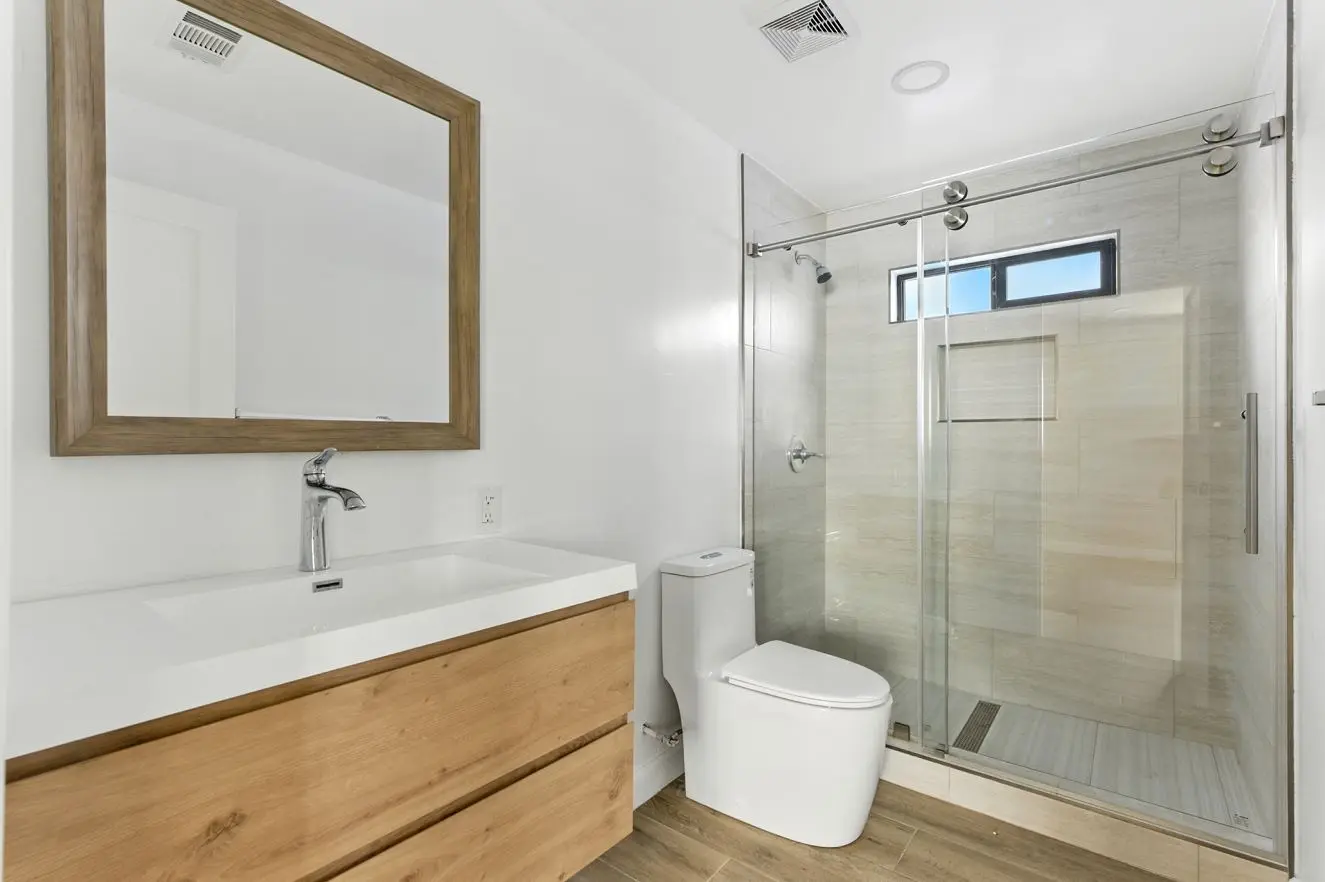
A permitted bathroom is inspected against specific measurements. These come from the LADBS bathroom requirements:
- Toilet clearance: a clear space at least 30 inches wide, with at least 24 inches clear in front of the bowl.
- Shower surfaces: floors and walls finished in a smooth, hard, non-absorbent material such as cement, concrete or ceramic tile, to at least 70 inches above the drain.
- Shower and tub glass: fully tempered glass at least 1/8 inch thick, laminated glass at least 1/4 inch thick, or an approved plastic.
- Number of inspections: for the express permit, usually one final inspection when the work is complete.
For a bathroom remodel permit, LADBS takes the final inspection request under code 335 on its automated inspection line: 311 from inside Los Angeles County, or (213) 482-0000 from outside it.
What a bathroom permit can require elsewhere in the house
This is the part that surprises homeowners, because the requirements reach beyond the bathroom being remodeled.
| Requirement | When it applies | What it means |
|---|---|---|
| Water-conserving plumbing fixtures | Single-family homes built on or before January 1, 1994, for any permitted alteration | Before the permit can be finaled, every noncompliant fixture in the house is replaced: toilets using more than 1.6 gallons per flush, showerheads above 2.5 gallons per minute, and interior faucets above 2.2 gallons per minute |
| Smoke alarms | Any alteration, repair or addition that requires a permit | The home is equipped with smoke alarms in the locations required for a new house |
| Carbon monoxide alarms | Every existing home with a fuel-fired appliance, a fireplace or an attached garage with an opening into the home, permit or not; and new alarms when an addition is built or a fuel-burning appliance or fireplace is added | Alarms installed as the California Residential Code requires. Plumbing work alone does not trigger new alarms |
The fixture rule is California Civil Code sections 1101.2 to 1101.4, and it covers fixtures in rooms you are not touching. The same law already required owners of these homes to replace noncompliant fixtures by January 1, 2017, permit or not; the permit is where it gets checked. The alarm rules are California Residential Code sections R310.2.2 and R311.2 in the 2025 edition, in effect since January 1, 2026. Where the work does not open up walls or ceilings, battery-operated alarms are generally allowed in place of new hardwired ones.
The fixture rule also follows the house to the sale: a seller has to disclose in writing whether the property still has noncompliant plumbing fixtures. Source: California Civil Code 1101.4.
Who can pull the permit
- A licensed contractor pulls it under their license. Los Angeles County notes the advantage: Building and Safety can then verify the contractor’s license and insurance.
- The owner, as an owner-builder, can build or improve on their own property, doing the work personally or with employees paid wages, when none of the improvements are intended or offered for sale (Business and Professions Code 7044). Selling within a year of completion creates a legal presumption that the work was done for sale.
- Unlicensed help is limited to a project under $1,000 in total that needs no building permit and is not part of a larger project, and only for someone who does not present themselves as a contractor or use helpers (Business and Professions Code 7048, as amended effective January 1, 2026).
How long the permit stays valid
Under Los Angeles County’s rules, a permit expires if work has not started within 12 months of issue, or if work stops for more than 180 days after it starts. Extensions of 180 days can be requested in writing. An application with no permit issued expires after 12 months. Inspections are requested at least 24 hours ahead. City of Los Angeles and independent-city timelines can differ, so confirm them with the department that issued the permit.
Permit processing belongs in the schedule from the first day, the same way it does in how long a kitchen remodel takes.
How we handle it
On a bathroom remodel, we submit all the permit applications the plumbing, electrical and mechanical scope requires, file any building permit the work needs, and coordinate the inspections. The same applies to every home remodeling project we take on. For the final word on a specific address, the building department that covers it is the authority.