In Los Angeles, the best time for foundation repair that involves digging or pouring concrete is the dry stretch from June through September, with May and October close behind. About 82% of downtown Los Angeles’s yearly rain falls from December through March, and freezing is not a concern, though valley nights can get cold enough in midwinter to matter for a concrete pour. For a foundation that is actively moving, though, the right time is as soon as the repair is designed and permitted, whatever the month.
Much of the advice that ranks for this question comes from contractors in other climates, including Northern California and the Southeast. Here is what the local weather record shows, which kinds of work it affects, and why the permit sets the calendar more than the season does.
What the Los Angeles weather record shows
These are NOAA’s 1991 to 2020 climate normals for the downtown Los Angeles station at USC. Inland valleys run hotter in summer and cooler at night. The rainfall pattern holds in the San Fernando Valley too: Burbank’s normal is 13.91 inches a year, with about 82% of it falling from December through March.
| Month | Normal rainfall (inches) | Days with 0.10 inch of rain or more | Normal low (°F) | Normal high (°F) |
|---|---|---|---|---|
| January | 3.29 | 4.4 | 48.9 | 68.0 |
| February | 3.64 | 4.7 | 50.0 | 68.0 |
| March | 2.23 | 3.3 | 52.4 | 69.9 |
| April | 0.69 | 1.4 | 54.8 | 72.4 |
| May | 0.32 | 0.7 | 58.1 | 73.7 |
| June | 0.09 | 0.2 | 61.4 | 77.2 |
| July | 0.02 | 0.1 | 64.7 | 82.0 |
| August | 0.00 | 0.0 | 65.4 | 84.0 |
| September | 0.13 | 0.2 | 64.2 | 83.0 |
| October | 0.58 | 1.1 | 59.9 | 78.6 |
| November | 0.78 | 1.7 | 53.1 | 72.9 |
| December | 2.48 | 3.6 | 48.2 | 67.4 |
Three things follow from the table. The year’s rain is concentrated in four months: 11.64 of 14.25 inches falls from December through March. Even in the wettest month, February, there are fewer than five days with a tenth of an inch of rain, so winter work is interrupted by storms rather than shut down for the season. And freezing nights are essentially absent: NOAA counts none in a normal year downtown and fewer than one in Burbank.
Cold still matters a little for concrete. The American Concrete Institute treats concrete work as cold-weather work when the air temperature falls, or is expected to fall, below 40°F while fresh concrete is being protected. Downtown Los Angeles averages about 2 nights a year below 40°F. Burbank averages about 21, mostly in December (7.5) and January (5.7), so a winter pour in the valleys may need cold-weather protection on those nights.
How the season affects each kind of foundation work
| Season | Works well for | What to plan around |
|---|---|---|
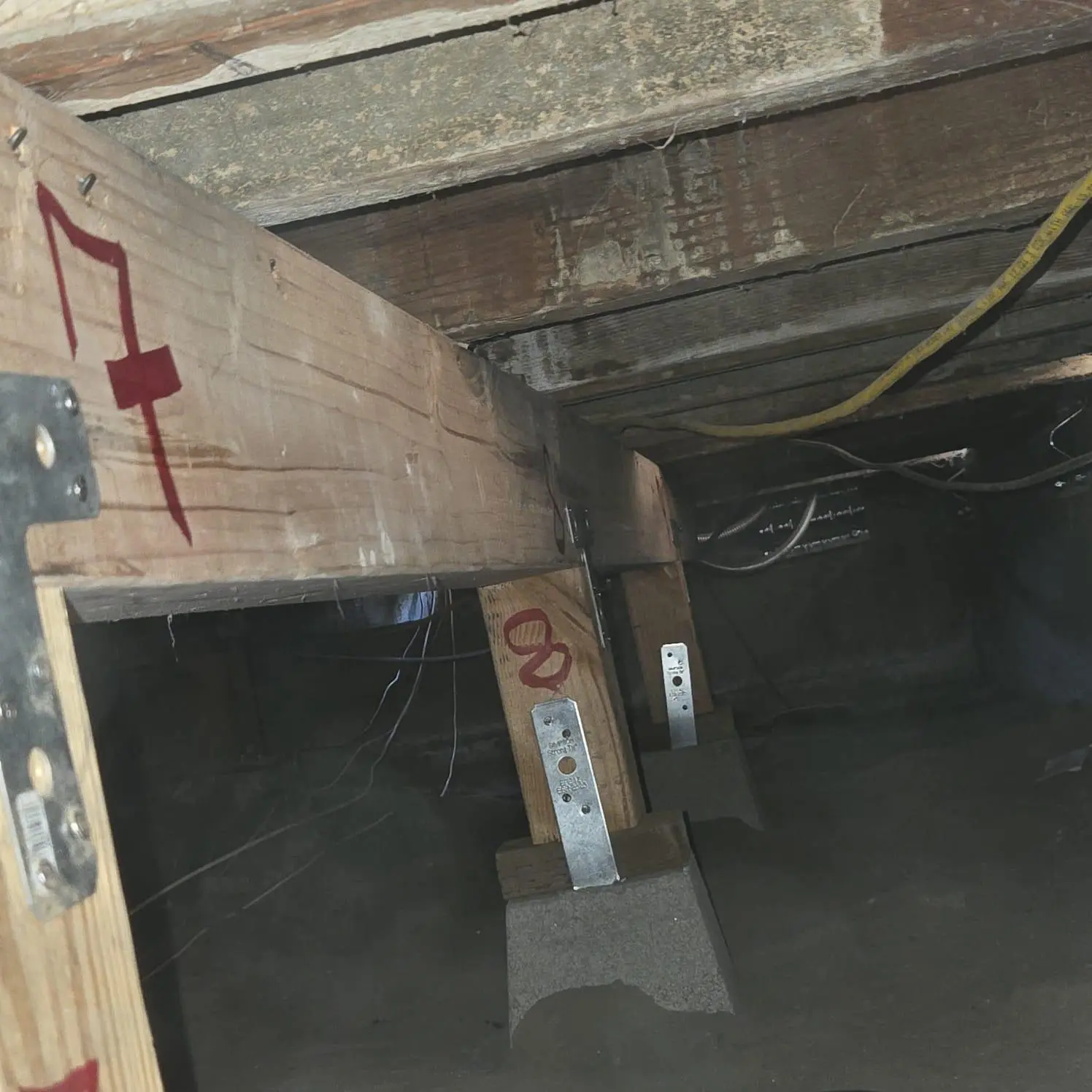
| December to March, the wet season | Seeing where water actually goes around the house, and work inside a crawl space, which rain largely does not reach | Excavation in wet soil, and concrete pours rescheduled around storms |
| April, May, October and November | Most exterior work, with little rain and mild temperatures | An early or late storm, and the first rains of the season arriving in October or November |
| June to September, the dry season | Excavation, drainage correction and concrete, with almost no rain to stop the work | Heat in the valleys. Burbank averages 14.2 days at 90°F or hotter in August, against 6.3 downtown |
Why the soil makes timing matter less than the condition
Much of the Los Angeles basin sits on expansive clay that swells when winter rain soaks it and shrinks through the dry summer. That cycle is why some cracks open and close with the seasons, and it is a reason to track a crack before deciding what it means: photograph it with a date and a ruler in frame, and look again in three months.
It is not a reason to wait on a foundation that is clearly moving. Doors that stop latching, floors that slope more each year, and cracks that keep widening are covered in our guide to the signs of foundation problems. Those conditions keep getting worse, and the repair is designed for the soil either way.
The permit sets the calendar more than the weather
Where the work falls on the calendar depends heavily on the permit it needs, and that is decided before any digging starts.
| Type of work | How much weather matters | Permit in the City of Los Angeles |
|---|---|---|
| Crack injection and surface patching | Little | Generally no permit |
| Anchor bolts and cripple wall plywood per LA City Standard Plan #1 | Little, most of the work is in the crawl space | Express permit, no plan check |
| Foundation replacement per LA City Standard Plan #1 | A lot, it involves excavation and concrete | Express permit, no plan check |
| Underpinning, piers and other structural changes | A lot | Plan check, with calculations sealed by a structural engineer |
The practical result: if you want structural work done in the dry season, the engineering and plan check are best started in winter. Outside the City of Los Angeles, Los Angeles County and independent cities such as Pasadena, Burbank and Santa Monica run their own permit processes.
How we handle it
For foundation repair in Los Angeles, we coordinate the structural engineer, file the LADBS permit, and schedule the work around the weather and your household routine once the permit is issued. Smaller jobs such as foundation crack repair start with a check of whether the scope needs a permit at all, and a seismic retrofit can often be done in the crawl space in any month.