Both materials are code-approved, both will outlast the galvanized pipe they are replacing, and in Southern California the choice comes down to three things: how hard your water is, where the pipe has to run, and how long you plan to own the house. Most of the arguments you will read online are about a fourth thing, freezing, which barely applies here.
That matters more than it sounds, because freeze resistance is one of the strongest arguments for PEX in almost every comparison published. Remove it and the two materials sit closer together than the internet suggests.
What each one is
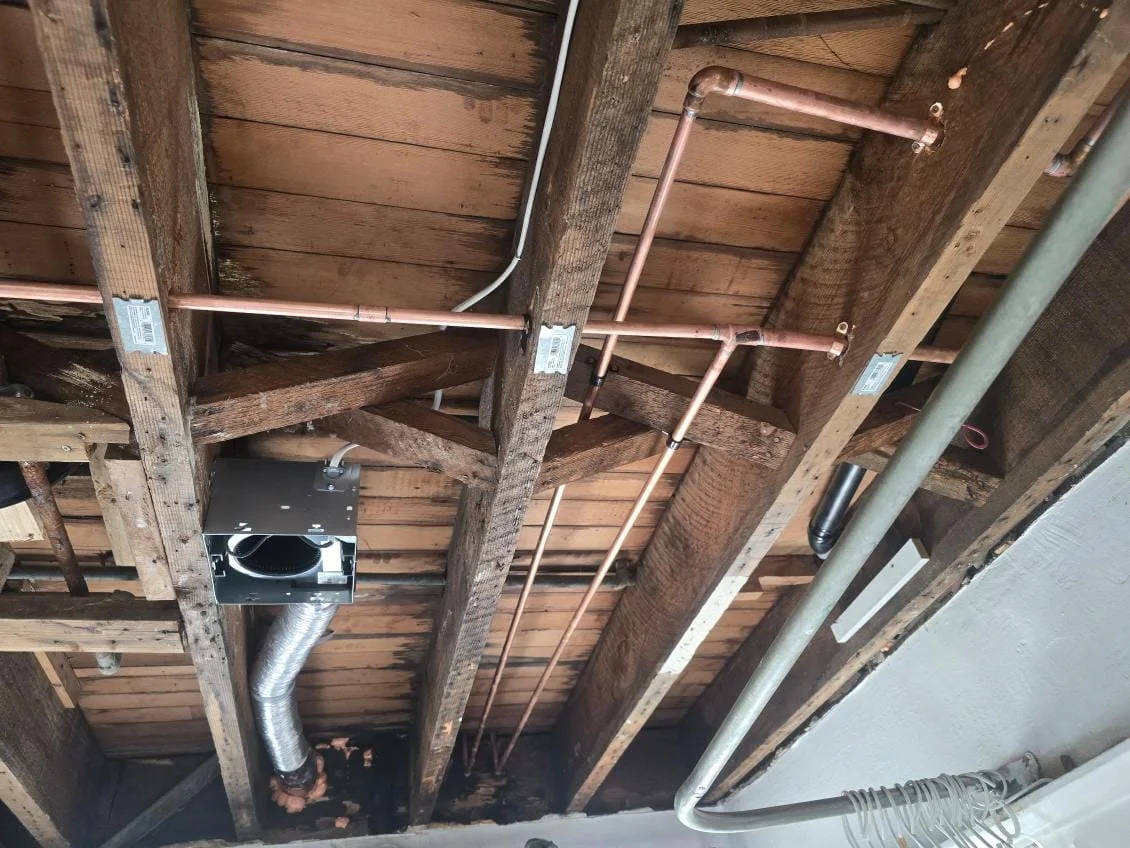
Copper is rigid tube, joined by soldered or pressed fittings. It has been the standard residential supply material for decades and its behavior over time is thoroughly documented.
PEX is flexible cross-linked polyethylene tubing, joined with mechanical fittings. It can be run in long continuous lengths through wall cavities with far fewer joints, which is both its main installation advantage and the reason a repipe with it is usually less invasive.
The comparison
| Copper | PEX | |
|---|---|---|
| Expected service life | Commonly cited at 50 years or more | Commonly cited around 50 years, with less field history at that age |
| Hard water | Vulnerable. Scale and aggressive water are associated with pinhole leaks | Resists scale and mineral buildup. The clear advantage here |
| Joints | Many, each one soldered or pressed | Few, and long runs can be made continuous |
| Disruption during a repipe | More access openings, more time in the walls | Fewer openings, faster, less drywall repair |
| Exposure to sunlight | Fine outdoors and in exposed runs | Degrades in UV. Cannot be used where it is exposed |
| Rodents | Not vulnerable | Can be chewed through. Matters in attics and crawl spaces |
| High temperature runs | Handles heat well, including recirculation loops | Rated for domestic hot water, with limits on sustained high temperature |
| Freeze behavior | Can split if water freezes inside it | Expands, so it tolerates a freeze better |
| Theft risk | Scrap value makes exposed copper a target | No scrap value |
| Best fit | Exposed runs, recirculation loops, long ownership horizon, softer water | Whole-house repipes in hard water, occupied homes, complex routing |
Why freeze resistance should not decide this here
Almost every comparison you will find gives significant weight to what happens when water freezes inside a pipe. It is a genuine difference: copper splits, PEX expands and usually survives.
It is also close to irrelevant across most of this region. One of the articles ranking on a Los Angeles search for this question is written for Ohio, and a nationally known plumbing figure quoted on the same page frames the decision around whether you live somewhere with extremely low temperatures.
If you are weighing this in Southern California, discount that row and read the rest of the table.
Hard water is the argument that should decide it
Water across much of this region is hard, and that cuts against copper specifically.
Mineral content and water chemistry are associated with pinhole leaks in copper supply lines: small perforations that appear without warning, often in runs that look fine from outside. It is not universal and it depends on local water and on how the system was installed, but it is the single most common reason a copper system fails earlier than its published life.
PEX does not corrode and does not scale in the same way, which is why it tends to be the default recommendation for a whole-house repipe in a hard water area. If the copper you are replacing failed by pinholes rather than by age, that is direct evidence about your own water.
Where PEX genuinely loses
Two constraints matter more here than the national comparisons suggest, and an honest answer names them.
PEX degrades in sunlight. Any run that is exposed, on an exterior wall, through an open patio structure or anywhere daylight reaches it, has to be copper or has to be protected. That is a real constraint on properties where plumbing was routed outside at some point, which is common in older Southern California houses that have been extended.
Rodents chew it. In a region where plumbing frequently runs through vented attics and open crawl spaces, that is a live risk rather than a theoretical one. It is manageable with routing and with sealing the spaces properly, but it is a genuine argument for copper in a house with a known rodent history.
Copper also handles sustained high temperature better, which matters if the house has a hot water recirculation loop.
What copper loses that people forget
A copper repipe involves far more joints, and a joint is where a system fails. It also takes longer and requires more access openings in walls and ceilings, which means more drywall repair and more days of living in a construction site.
Exposed copper is worth stealing. In this region that is a practical consideration for anything running outside the building envelope, not a curiosity.
The requirement nobody mentions
A repipe is permitted work, and the 2025 Energy Code added piping insulation requirements that apply to it, including insulation on the first eight feet of cold water piping. That is new enough that most published comparisons predate it, and it is not optional on permitted work.
Ask whoever quotes the job to confirm the pipe insulation scope is included, because it is exactly the kind of item that turns up as an extra later. The standards are published by the California Energy Commission.
The verdict
For a whole-house repipe in an occupied Southern California home, PEX is the default and the reasoning is hard water plus disruption. It resists exactly the failure mode this region’s water produces, and it goes in with fewer openings in your walls.
Choose copper where the runs are exposed to sunlight, where there is a recirculation loop, where there is a known rodent problem in the attic or crawl space, or where you intend to hold the house for a very long time and prefer the material with the longer field record. Mixed systems are normal and often correct: copper for the exposed and hot runs, PEX for everything inside the walls.
What should not decide it is freeze protection, and what should decide it is your water. If you are still on original galvanized supply lines, the material question is second anyway. The signs of galvanized pipe failure are the thing worth confirming first, because they tell you how urgent this is.
Common questions
What is better, copper piping or PEX piping?
Neither is better in general, and the honest answer is conditional. In hard water, for a whole-house repipe in a home people are living in, PEX has the stronger case: it resists scale, it installs with fewer joints, and it needs fewer openings in the walls. Copper has the stronger case for exposed runs, recirculation loops, and homes with a rodent problem. Most well-designed repipes in this region use both.
Why is copper piping no longer used?
It is still used, widely. The premise of the question comes from PEX taking a large share of new residential work on cost and installation speed, not from copper being withdrawn or failing generally. Copper remains code-approved, remains standard for exposed and high-temperature runs, and is specified deliberately on plenty of projects.
Does PEX fail more than copper?
The failure modes differ more than the failure rates. Copper in this region tends to fail by pinhole corrosion driven by water chemistry. PEX tends to fail at fittings, from UV exposure where it should not have been used, or from physical damage including rodents. Both are reliable when correctly specified and installed, and installation quality is a larger variable than material choice.
Why don’t insurance companies like PEX plumbing?
This comes up often enough to be worth addressing, and the honest answer is that we cannot tell you what your insurer thinks. PEX is code-approved and in widespread use. The reputational shadow mostly traces to earlier plastic supply systems and to specific fitting problems that were dealt with years ago, which is a different material from what is installed today. If it matters to your decision, ask your own insurer directly rather than relying on a general claim in either direction.
What is the best type of plumbing piping for a house?
The one specified for the conditions in that particular house. Water hardness, whether runs are exposed, whether there is a recirculation loop, the routing available, and how long you plan to own it all change the answer. A contractor who recommends the same material for every house without asking about the water is not answering the question.
Can you mix copper and PEX in one house?
Yes, and it is common in a well-planned repipe. Copper handles the exposed runs and anywhere sustained high temperature is involved; PEX handles the concealed distribution. The transitions require the correct fittings, and dissimilar metal connections need to be made properly, which is an installation quality question rather than a reason to avoid mixing.