What Walkway and Driveway Construction Involves for Southern California Properties
Walkway and driveway construction is the excavation, base preparation, and installation of a durable paved surface designed for pedestrian or vehicle access across a residential property. In Southern California, the durability of any paved surface is determined more by what happens below the visible surface than by the material on top of it. The region’s expansive clay soils swell when wet and contract during the long dry season, producing a cyclic movement that transmits directly to any surface installed on inadequately prepared subgrade. A concrete driveway poured on an uncompacted clay subgrade without an adequate aggregate base will crack, heave, and settle within a few wet seasons, regardless of the quality of the concrete mix. A paver walkway set in sand on an uncompacted base will develop low spots, lifted units, and drainage problems that worsen with each season. Proper base preparation, which means excavating to the required depth, treating or addressing expansive subgrade conditions, installing and compacting an aggregate base at the required depth, and establishing the drainage grade before any surface material is placed, is the investment that determines whether a walkway or driveway performs correctly for its intended lifespan. Everything visible on the surface depends on getting that right.
Walkway and Driveway Scopes We Build
Concrete Driveways
Poured concrete driveways are the most widely installed driveway surface in Southern California residential applications because they provide the best combination of vehicle load capacity, maintenance requirements, and longevity when correctly constructed. We pour driveways at the required slab thickness for the expected loading, with reinforcing steel at the appropriate size and spacing, control joints saw-cut or formed at the correct intervals to manage shrinkage cracking, and an aggregate base at the required compacted depth for the soil conditions. Concrete finish options include standard broom texture for a non-slip surface, exposed aggregate for a more decorative appearance, and stamped patterns for homeowners who want the look of pavers or stone at a lower material cost. The finish is a surface choice. The base is structural, and we do not compromise it for either option.
Concrete Paver Driveways and Walkways
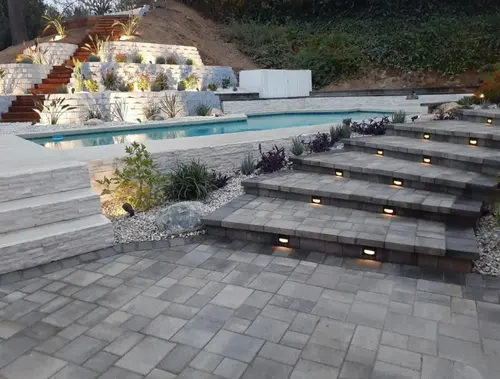
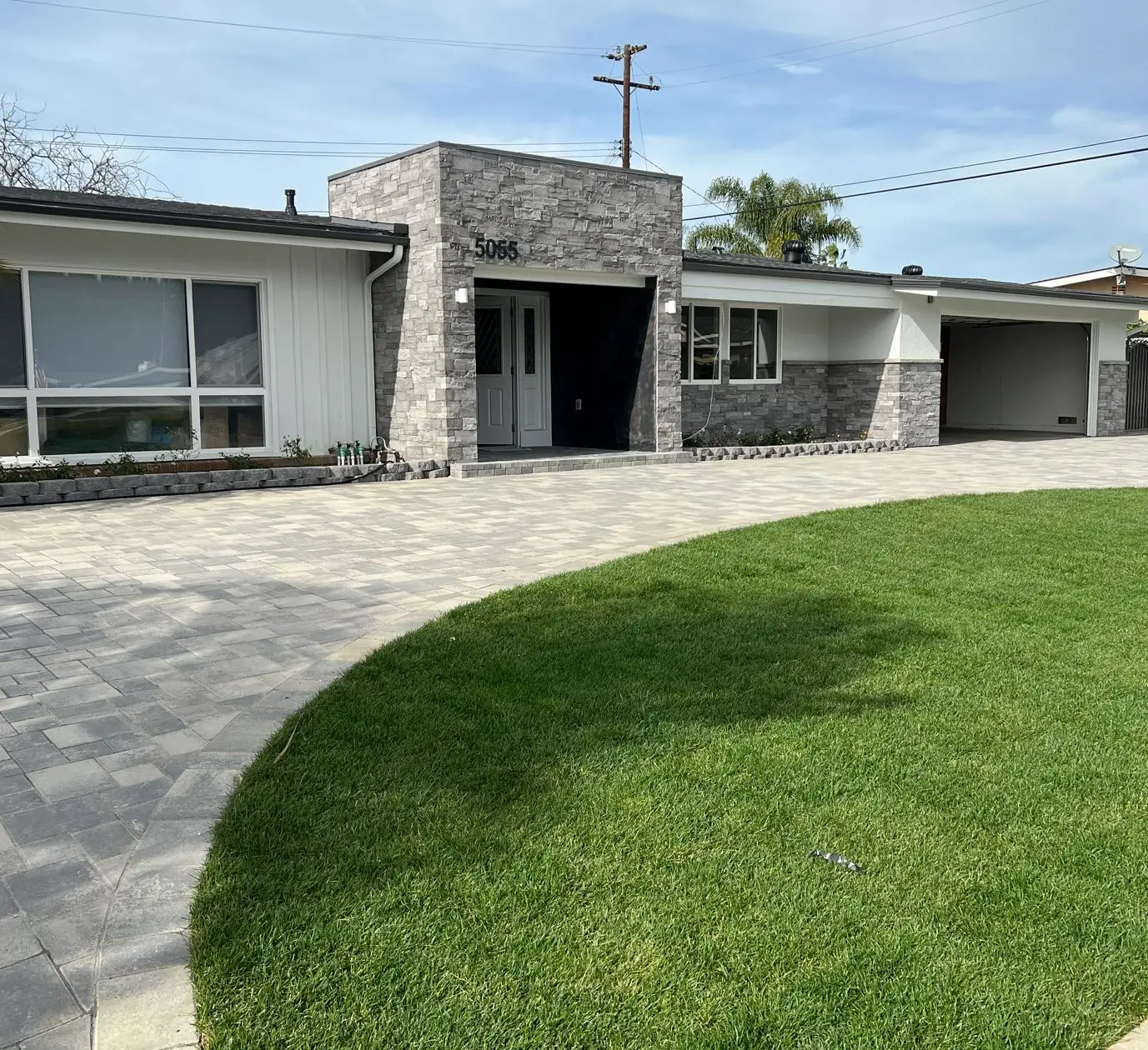
Concrete paver driveways and walkways use individual precast units set in a sand bedding layer on a compacted aggregate base, with edge restraints at the perimeter to prevent lateral spreading. Pavers are available in a wide range of sizes, profiles, colors, and patterns. Their advantages over poured concrete for driveways include individual unit replaceability when a paver is damaged or stained without disturbing the surrounding surface, greater tolerance for minor differential movement in the subgrade, and design flexibility that monolithic concrete cannot match. For walkways, pavers allow curves, patterns, and material transitions that define entry paths and garden walks in ways standard concrete does not. We design paver installations with the sand bed, edge restraint, and drainage details that maintain performance through Southern California’s wet-dry soil cycling.
Flagstone and Natural Stone Walkways
Flagstone, slate, and other natural stone materials are appropriate for pedestrian walkways where the primary design priority is a natural, organic appearance. Stone walkways can be set in a mortar bed on a concrete base for maximum stability on primary entry paths, or dry-set in sand or decomposed granite for informal garden paths where a more natural setting and some movement between units is acceptable. We specify the setting method appropriate for the stone type, the intended foot traffic, and the site conditions, and we seal mortared stone joints and stone surfaces at completion, where the material and use warrant it.
Asphalt Driveways
Asphalt is a cost-effective driveway surface for properties where the lower upfront cost is the primary consideration and the homeowner understands that asphalt requires periodic sealcoating to maintain its surface and has a shorter lifespan than concrete before resurfacing is needed. We install asphalt driveways on properly prepared base material, not over unstabilized subgrade, and we grade for adequate drainage as standard scope. Asphalt is a practical choice for properties with large driveway areas where the cost difference from concrete is significant, or for driveways that will be replaced or resurfaced as part of a larger project scope in the future.
Driveway Replacement and Demolition
Many Southern California homes have existing concrete driveways from the 1960s through the 1990s that are cracked, settled, or stained beyond what surface repair can address. Driveway replacement involves breaking up and removing the existing slab, assessing and correcting the subgrade conditions that may have contributed to the existing slab’s failure, and installing a new slab on a correctly prepared base. We haul off all broken concrete as part of the replacement scope. For homeowners upgrading from concrete to pavers during the replacement, the demolition of the existing slab is included in the paver installation estimate rather than priced separately.
Base Preparation and Slab Specifications for Southern California
| Application | Minimum Slab Thickness | Minimum Aggregate Base | Reinforcement |
|---|---|---|---|
| Residential pedestrian walkway | 3.5 to 4 inches | 3 to 4 inches compacted | Fiber reinforcement in mix |
| Residential driveway, passenger vehicles | 4 inches | 4 to 6 inches compacted | #3 rebar at 18 inches on center each way |
| Residential driveway, heavy vehicles or RV | 5 to 6 inches | 6 inches compacted | #4 rebar at 12 to 18 inches on center |
| Paver driveway, passenger vehicles | N/A, pavers on sand bed | 6 to 8 inches compacted aggregate base | Edge restraints required perimeter |
| Paver walkway, pedestrian | N/A, pavers on sand bed | 4 to 6 inches compacted aggregate base | Edge restraints required perimeter |
According to the American Concrete Pavement Association, proper subbase compaction and joint placement are the two most critical factors in the performance and longevity of residential concrete pavement. In Southern California, where expansive clay soils create subgrade movement that other regions do not experience at the same intensity, base preparation is not a step to abbreviate, and the aggregate base thickness specified above reflects the conditions the region’s soils impose rather than a generic national standard. For homeowners planning a driveway replacement as part of a broader hardscape project that includes a new patio or walkways, our patio construction services use the same base preparation standards and can be coordinated in the same project to reduce total mobilization cost.
What Walkway and Driveway Construction Costs in Southern California
Cost is driven by surface area, material selection, demolition scope, site access, and drainage requirements. These are installed cost ranges, including all demolition where applicable, excavation, base preparation, material, installation, and standard cleanup. Permit fees, where required, vary by jurisdiction. Financing is available for qualified homeowners, including $0 down options.
Call (818) 483-8055 to schedule your free walkway and driveway estimate.
Our Walkway and Driveway Construction Process
Step 1: Free Site Visit and Estimate
A licensed Wise Choice estimator visits your property, measures the project area, assesses the existing surface condition and any demolition required, evaluates the subgrade and drainage conditions, confirms any permit requirements for the specific scope, and discusses material options. You receive a written itemized estimate before the end of the next business day with no obligation to proceed.
Step 2: Permit and HOA Confirmation
For new driveway construction that requires a curb cut or for projects in HOA-governed communities, we confirm and submit the required applications and factor the review timeline into the project schedule. We do not begin excavation until all required approvals are confirmed.
Step 3: Demolition and Removal
Where an existing surface is being replaced, the old concrete, asphalt, or paver surface is broken up, removed, and hauled off-site. All demolished material is removed before excavation for the new base begins. The subgrade is exposed and assessed for soft spots, expansive soil conditions, or other conditions that should be addressed before the new base is installed.
Step 4: Excavation and Base Preparation
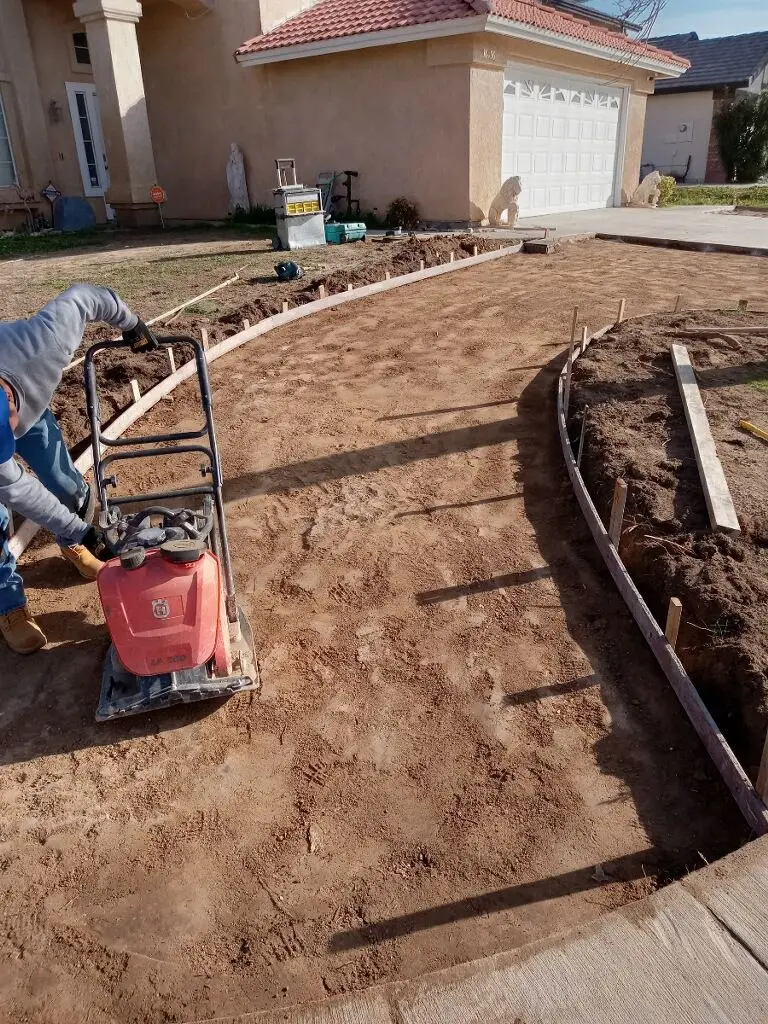
The area is excavated to the required depth for the combined base and surface thickness. The subgrade is graded to the drainage slope required for the specific surface and use, compacted with plate compaction equipment, and assessed for adequate bearing before the aggregate base is placed. Aggregate base is installed in lifts at the required total depth, with each lift compacted before the next is placed. No surface material is installed until the base compaction is confirmed adequate.
Step 5: Surface Material Installation
For concrete installations, forms are set at the correct elevation and drainage grade, reinforcing steel is placed at the required size and spacing, and concrete is placed, screeded, and finished to the specified texture. Control joints are formed or saw-cut at the required spacing after pour. For paver installations, the bedding sand is screeded to grade, pavers are set and compacted into position, cut units are made at perimeter edges, and edge restraints are secured. For stone installations, the setting bed and mortar or sand work is completed, units are set and leveled, and joints are filled with the specified material.
Step 6: Drainage Integration and Cleanup
Channel drains, catch basins, or other drainage features included in the scope are installed and connected before surface restoration around them is completed. All debris, packaging, and excess material are removed from the property. Surrounding landscaping disturbed by the project is restored. At project closeout, you receive the 2-year workmanship warranty in writing and permit documentation where applicable.
If you are ready to get a written estimate for a new or replacement walkway or driveway, request a free estimate online or call (818) 483-8055 to schedule your site visit.
Permits and California Requirements for Walkways and Driveways
New driveway construction that requires a new or modified curb cut requires approval from the applicable city or county public works or transportation department, in addition to a standard building permit in most Southern California jurisdictions. Curb cut permits are required because the modification affects the public right-of-way and the drainage design of the street. We identify the applicable curb cut requirements during the estimate visit for new driveway installations and manage the application process.
Driveway replacements within the same footprint are generally permit-exempt in most Southern California jurisdictions, though some cities require a permit for any concrete flatwork above a certain square footage or for any work within a specific distance of a property line or easement. We confirm the applicable permit requirements for the specific project scope and address during the estimate visit.
California’s stormwater regulations require that new impervious surfaces not increase the stormwater discharge rate from the site, which, for residential driveways in practice, means ensuring adequate drainage design and, in some jurisdictions, may require permeable paving or other low-impact development measures for large driveway areas. We identify any applicable stormwater management requirements during the estimate visit and include compliant drainage design in every project scope.
Why Southern California Homeowners Choose Wise Choice for Walkways and Driveways
15+ Years of Combined Experience Building Walkways and Driveways
We have built and replaced walkways and driveways across Southern California’s full range of soil conditions, site configurations, and architectural contexts. The base preparation decisions that determine long-term performance are invisible once the project is complete, and our crew makes those decisions correctly rather than cutting the steps that save time on site at the expense of performance after the first few wet seasons.
Licensed and Insured General Contractor
Every walkway and driveway project we perform is completed under our general contractor license by crew members fully covered by our insurance. You carry no liability exposure for work our team performs on your property.
Reinforcement and Control Joints as Standard
We include reinforcing steel and properly spaced control joints in every concrete slab project as standard scope, not as upgrades. Concrete poured without reinforcement on Southern California’s clay soils will crack. Control joints placed at the correct spacing manage where cracking occurs rather than allowing random cracking across the slab. These are not optional enhancements.
Drainage Design on Every Project
We establish the drainage grade on every walkway and driveway project and include channel drains or catch basins where the drainage conditions at the property require them. A driveway that drains toward the garage or toward the foundation is creating a problem that costs more to correct after the fact than to prevent during construction.
2-Year Workmanship Warranty
Our 2-year workmanship warranty covers all excavation, base preparation, material installation, and finishing work our crew performs. If any workmanship-related cracking, settling, or drainage failure develops within two years under normal conditions, we return and correct any workmanship deficiency at no charge. The warranty is in writing and delivered at project closeout.
Financing Available
Financing is available for qualified homeowners, including $0 down options. Ask about current programs when you schedule your estimate.
Wise Choice Remodeling brings 15+ years of combined experience to building walkways and driveways across Southern California. If your driveway is cracked, settled, or stained beyond repair, or if you want a new walkway built to hold up through Southern California’s seasonal conditions, call (818) 483-8055 to schedule a free site visit and get a written estimate on a project done correctly from the base up.