For most Southern California homes replacing a failed water heater like for like, a tank is still the right answer. Tankless wins on a shorter list of conditions than the marketing suggests: you run out of hot water regularly, you want the floor space back, you plan to stay in the house ten years or more, and you will actually maintain it. Miss that last one and a tankless unit is a worse buy than the tank it replaced.
That is the honest version. Here is the reasoning.
How each one works
A tank heats 40 or 50 gallons and holds it at temperature, ready. When it runs out, you wait while it recovers. Recovery rate is measured in gallons per hour and depends on the tank size, the fuel and the burner or element input.
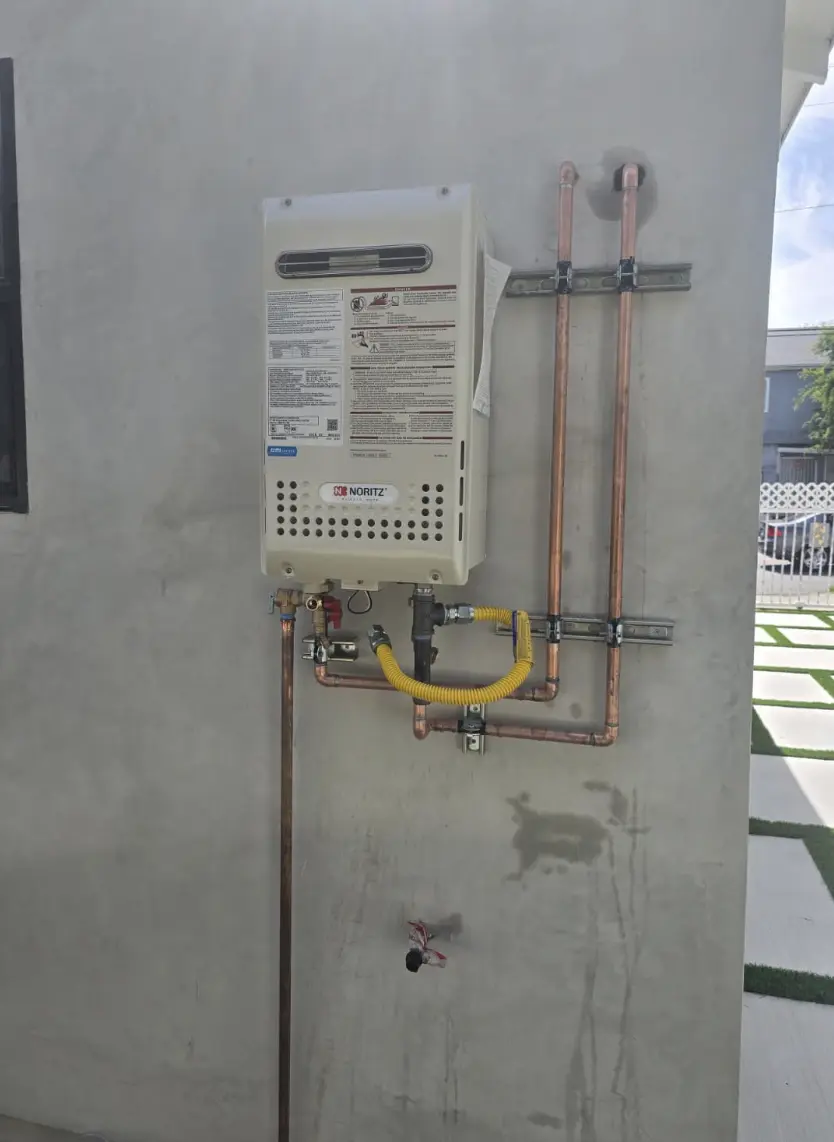
A tankless unit heats water as it flows. Nothing is stored. Open a tap and a heat exchanger fires; close it and the unit stops. There is no standby loss because there is nothing standing by.
There is a third option that gets left out of this comparison constantly. A heat pump water heater still has a tank, but it heats the water by moving heat out of the surrounding air rather than generating it. It is dramatically more efficient than a conventional electric tank. It needs air volume, clearance around it, and a space that stays reasonably warm, which in this climate usually means a garage.
The comparison
| Storage tank | Tankless | Heat pump | |
|---|---|---|---|
| Hot water delivery | Instant until the tank empties, then you wait for recovery | Continuous, but limited by flow rate when several fixtures run at once | Instant until the tank empties, slower recovery than gas |
| Typical lifespan | Around 8 to 12 years | 20 years or more, with maintenance | Comparable to a tank, longer with maintenance |
| Space | Large floor footprint | Wall mounted, small | Larger than a standard tank, plus clearance for airflow |
| Fuel and service | Works with existing gas or electric in most cases | Often needs a larger gas line, or a substantial electrical circuit | Needs a dedicated electrical circuit, and panel capacity |
| Standby loss | Yes, constant | None | Yes, but far smaller relative to output |
| Maintenance | Annual flush, anode rod checked periodically | Annual descaling, not optional in hard water | Annual filter and coil cleaning, plus tank flush |
| Permit burden | Permitted work, straightforward on a like-for-like swap | Permitted work, more inspection because gas and venting usually change | Permitted work, plus electrical if a circuit is added |
| Best fit | Like-for-like replacement, tight timeline, no hot water complaints | Households that run out of hot water, long ownership horizon, willing to maintain | All-electric homes and anyone prioritizing running cost, with a garage to put it in |
Hard water is the variable nobody mentions
This is the part the national guides skip and it matters more here than almost anything else in the table.
Water across much of Southern California is hard. Dissolved minerals precipitate out when water is heated, and inside a tankless unit that happens in a narrow heat exchanger passage. Scale builds, flow drops, the unit works harder, and eventually it faults or fails. Descaling once a year keeps it healthy. Skip it for a few years and you have shortened a 20 year appliance to something much less than that.
A tank tolerates neglect better. Scale settles in the bottom of the tank rather than choking a passage, and while it still costs efficiency and life, the failure is slower and more forgiving.
So the maintenance line in the table is not a footnote. It is the question. If nobody in the house is going to book a descaling service every year, buy the tank.
What actually drives the project
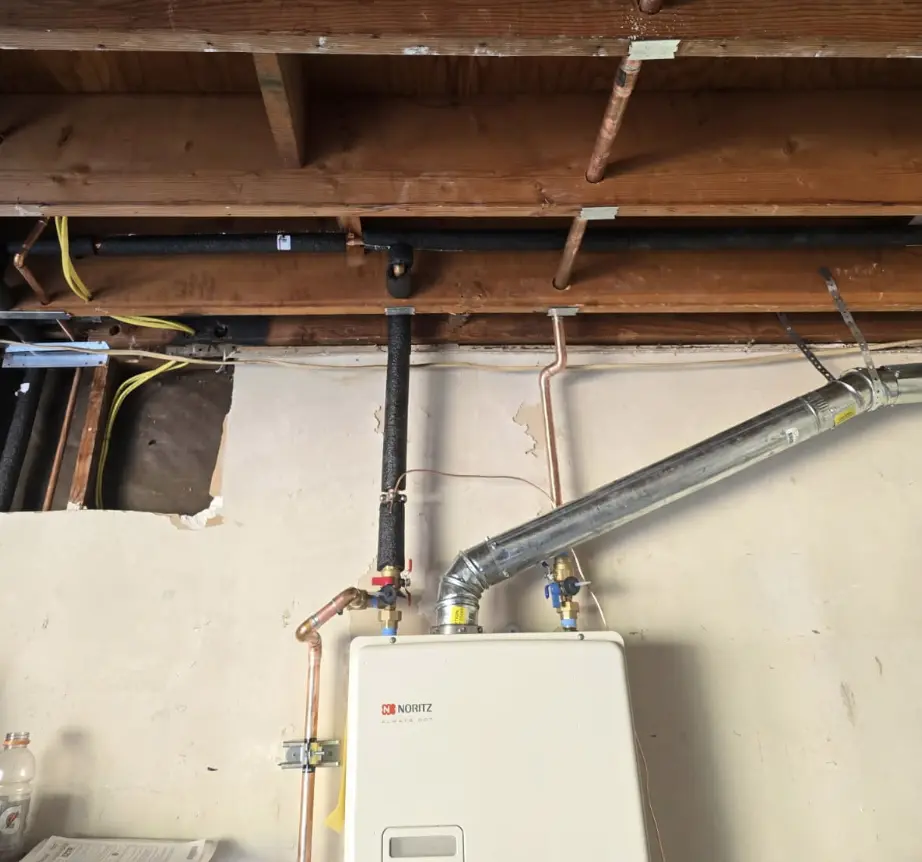
The unit is rarely the biggest variable in a tankless conversion. The gas supply and the venting usually are.
A tankless unit fires at a far higher rate than a tank burner, so the existing gas line frequently cannot feed it. That means a larger line run back toward the meter, and sometimes the meter itself. Venting changes too, because tankless units vent differently from an atmospheric tank. Neither of those is exotic work, but both add labor, both are inspected, and together they often outweigh the unit.
Electric tankless has the same problem in a different currency. Whole-house electric tankless draws enough current that many homes need a service or panel upgrade to support it.
None of this makes tankless a bad choice. It makes the comparison meaningless until somebody has looked at your gas line and your venting. A gas line upgrade is the single most common reason a tankless quote lands higher than expected, and it is knowable in advance.
Flow rate, and the two-shower question
A tankless unit does not run out of hot water. It runs out of flow.
Each unit heats a certain number of gallons per minute by a certain temperature rise. Ask for more than that and the water gets cooler rather than stopping. Two showers at once is usually fine on a correctly sized gas unit. Two showers plus a dishwasher plus a washing machine is where an undersized unit shows itself.
This is a sizing problem, not a technology problem, and it is the most common cause of a disappointed tankless owner. Sizing is done from fixture count and incoming water temperature, not from the square footage of the house.
It is permitted work either way
Replacing a water heater in California requires a permit, and permitted work brings the state energy code with it. That covers water heating alongside insulation, windows, and heating and cooling. A tankless conversion usually draws more inspection attention than a straight tank swap, because the gas line and the venting are changing rather than being reused.
This is worth knowing for a practical reason. An unpermitted water heater is a common finding at sale, and it is a cheap problem to avoid and an annoying one to fix later. Current standards are published by the California Energy Commission.
One thing to check before you choose either
If the house still has its original galvanized supply piping, the water heater is not the first problem. Old galvanized lines lose interior diameter to corrosion, which starves any water heater of flow and will make a correctly sized tankless unit behave like an undersized one. The signs of galvanized pipe failure are worth ruling out first, because replacing the heater will not fix them.
The verdict
Buy a tank if you are replacing a failed unit, nobody complains about running out of hot water, you want it done this week, or you know maintenance will not get booked. It is the lower-risk choice and it is the right one more often than the internet suggests.
Buy tankless if you regularly run out of hot water, you want the floor space, you are staying in the house long enough for a 20 year appliance to pay back, and you will maintain it. Get the gas line and venting assessed before you accept any number, because that is where the surprise lives.
Consider a heat pump water heater if the house is going electric anyway, you have a garage to put it in, and running cost matters more to you than upfront cost.
Anyone who recommends one of the three without asking about your fixture count, your gas line and your water hardness is selling, not advising. A proper tankless water heater assessment covers all three.